
Current
Research
The Stadium Project
Investigating a Regional Centre of Pilgrimage (2025-2029)
Assist. Prof. Dr. Peter Talloen
The ongoing excavations in the Stadium of Sagalassos investigate one of the most remarkable transformations in the city’s long history: the conversion of a major Roman civic and ceremonial space into a centre
of Christian worship during Late Antiquity. Situated on the western edge of the ancient city, the Stadium originally served as the venue for
athletic competitions associated with the Klareian festival in honour of Apollo Klarios, as well as gladiatorial games and wild animal hunts connected to the imperial cult. As such, it functioned as a focal point of civic identity, public spectacle, and regional gathering throughout the Roman Imperial period.
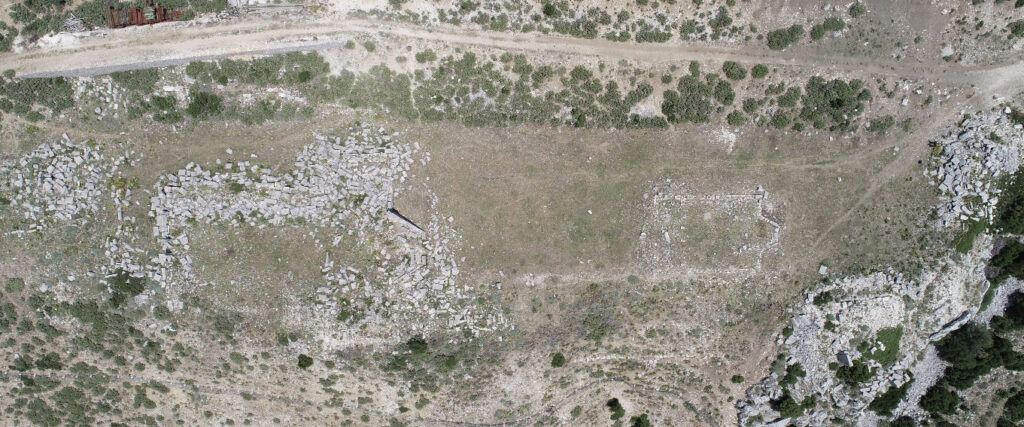
Aerial view of the Stadium
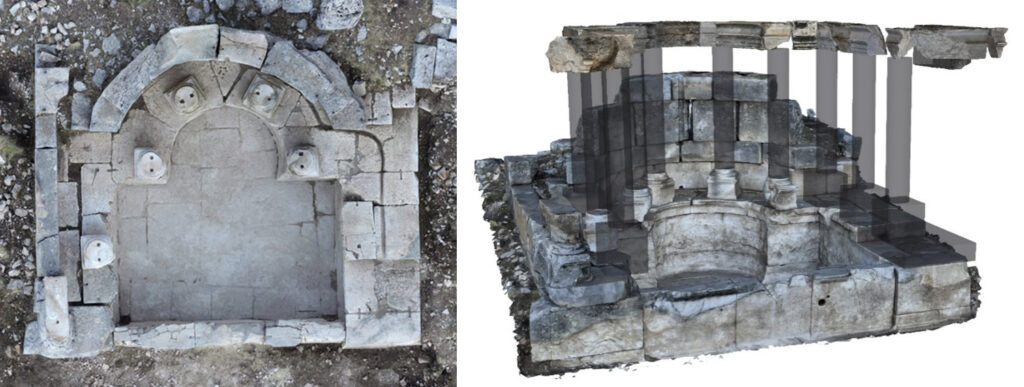
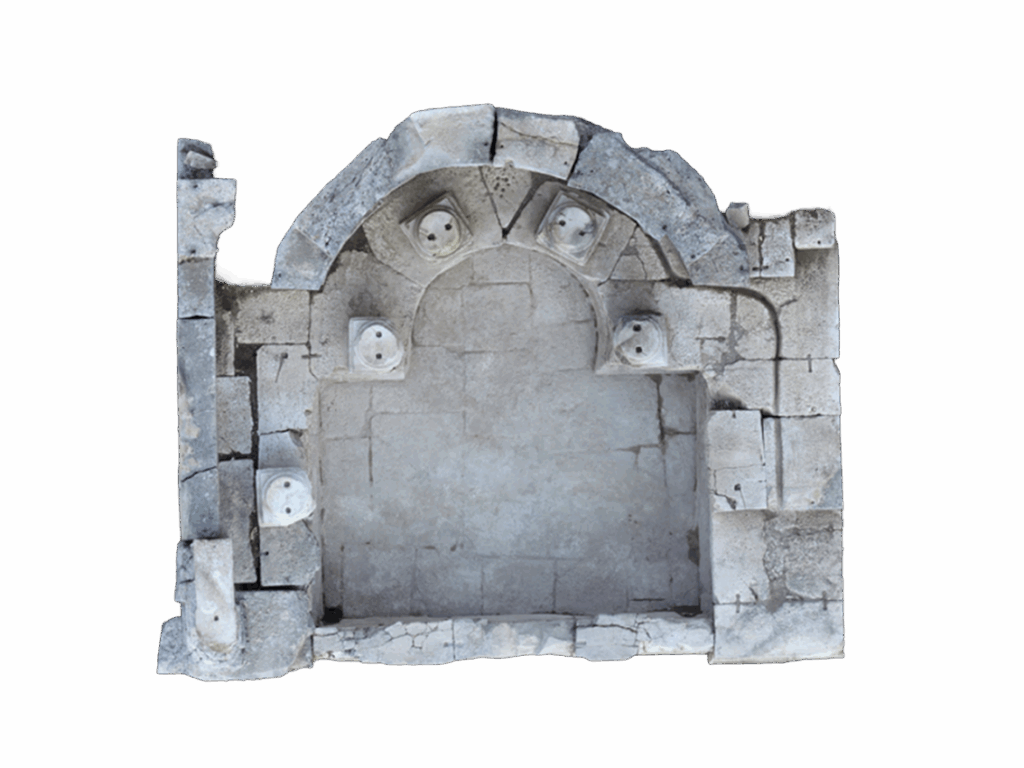
Orthophoto and existing-condition model of the Trajanic Nymphaeum
Recent archaeological research has demonstrated that the Stadium did not fall into disuse after the decline of traditional pagan institutions. Instead, between the late fourth and sixth centuries CE, it underwent a profound transformation through the construction of two monumental churches, including a large transept basilica. The churches were built using extensive spolia from dismantled pagan monuments, among them architectural elements from the neokoros sanctuary of Antoninus Pius and the Temple of Dionysos, thereby physically embodying the transition from the pagan to the Christian sacred landscape. Together with a monumental approach avenue, the Trajanic nymphaeum, some preserved seating of the Stadium, and a series of ancillary buildings, these structures formed an extensive religious complex.
The current excavation project aims to reconstruct the organisation, chronology, and function of this exceptional complex. Building upon the hypothesis that the Stadium became a regional pilgrimage centre dedicated to an as yet unidentified local saint or martyr, the project investigates how the architecture and associated material culture facilitated the emergence of new forms of Christian devotion and communal identity. Excavations target four principal components of the complex: the seating rows of the Stadium, the Trajanic nymphaeum, the entrance zone with its associated buildings, and key areas within the churches themselves such as the presumed mausoleum of the saint. Combined with geophysical survey, architectural documentation, archaeometric analyses, and the study of devotional material culture, these investigations seek to reconstruct the experience of worshippers and pilgrims within the sanctuary.
Beyond documenting architectural remains, the project addresses broader questions concerning the Christianisation of urban landscapes and the development of ‘lived religion’ in Late Antiquity. By examining an ordinary provincial city rather than one of the famous pilgrimage centres of the eastern Mediterranean, the excavations at Sagalassos provide a unique opportunity to investigate how local communities adapted
existing urban infrastructure to create new sacred spaces and how
these transformations reshaped religious practice, social interaction,
and regional identity during the transition from the Roman to the Byzantine world.
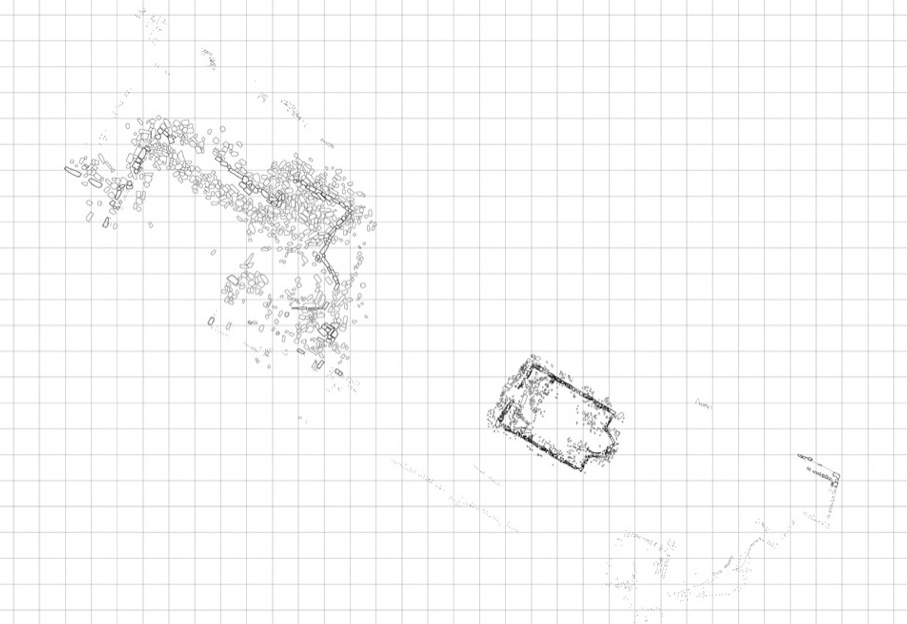
Plan of the Stadium,
with Basilica E1 (left) and
Basilica G (right) indicated.
Hellenistic Interaction Networks
Project is financially supported by
Vrije Universitet Amsterdam.
Hellenistic Interaction
Networks Project
(2026-2029)
Assist. Prof. Dr. Dries Daems
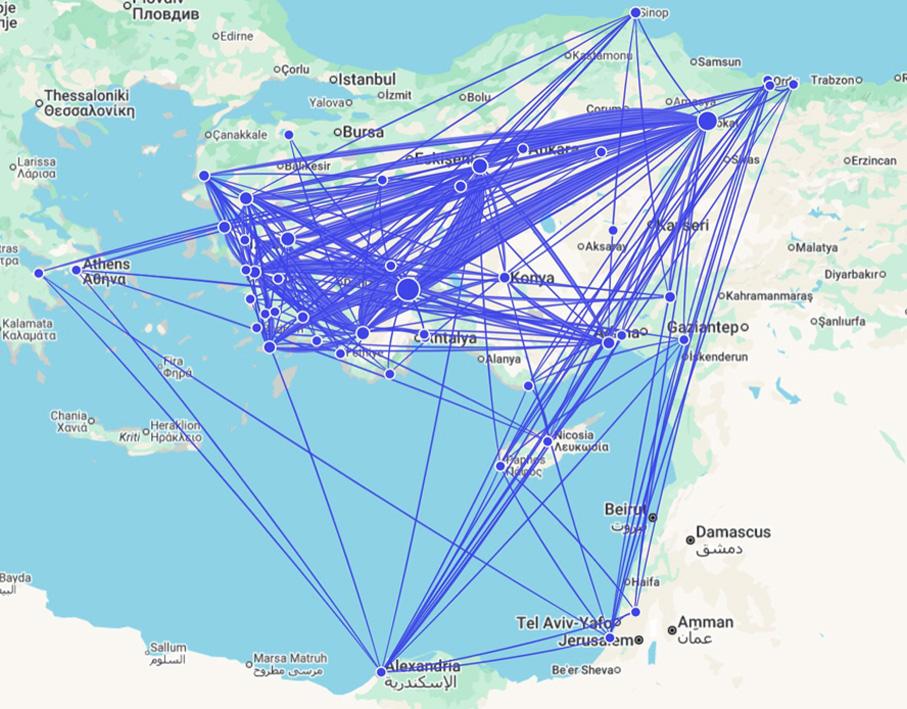
This project reconceptualizes the Hellenistic world as a network of networks, moving beyond simplistic assumptions of pervasive connectivity. Rather than treating interaction and integration as universal conditions, it investigates the dynamic and historically contingent interplay between connectivity and fragmentation across the eastern Mediterranean in Hellenistic times.
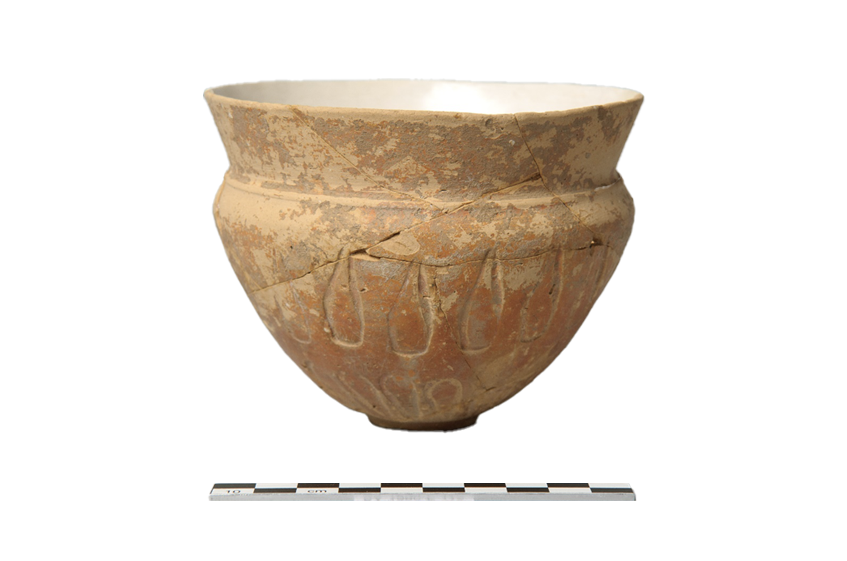
Drawing on comparative case studies, the project integrates two major lines of evidence: (1) urban development and interurban networks, and (2) material culture networks, with a particular emphasis on ceramic production, distribution, and consumption. Through this comparative framework, the project seeks to develop a more nuanced understanding of how social, economic, and cultural relationships were formed, maintained, disrupted, and transformed during the Hellenistic period.
The grant will support ongoing research at Sagalassos, one of the project’s principal case studies, through a series of archaeological soundings targeting Hellenistic urban infrastructure and intensive pottery analyses to be conducted between 2026 and 2029. By situating Sagalassos within broader regional networks, the project will significantly advance our understanding of its Hellenistic occupation, urban development, and community life, while contributing to a wider rethinking of connectivity and fragmentation in the Hellenistic Mediterranean.

Hellenistic Interaction Networks
Project is financially supported by
Vrije Universitet Amsterdam.
Sagalassos Seramik Atölyesi
Pottery Workshop Project (2026)
Dr. Senem Özden Gerçeker
Sagalassos Seramik Atölyesi project, initiated by Dr. Senem Özden Gerçeker, is a community engagement project that connects archaeological production with applied art education. By drawing inspiration from the continuous ceramic production tradition of ancient Sagalassos, which lasted nearly seven centuries, the workshop enables children to explore beyond mere observation of cultural heritage and become active participants who discover it through hands-on experience.
Organised with the main sposorship of Karaca, and the support of the Sagalassos Foundation and the Ağlasun District Governorship, the project allows children to examine archaeological artefacts, explore ancient production techniques, design their own creations using clay, and create a link between the past and the present. By connecting scientific archaeological research with the community, this educational model aims to enrich cultural heritage, foster creativity, and strengthen local solidarity within the region.
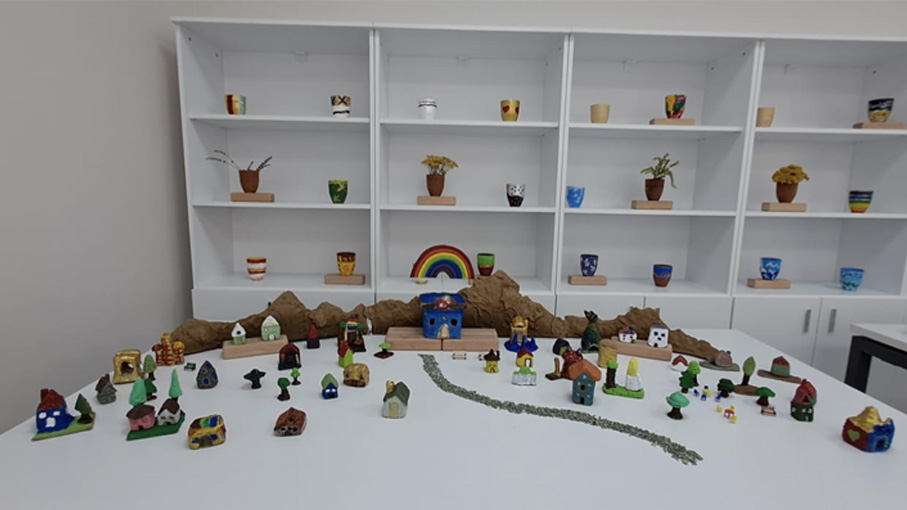
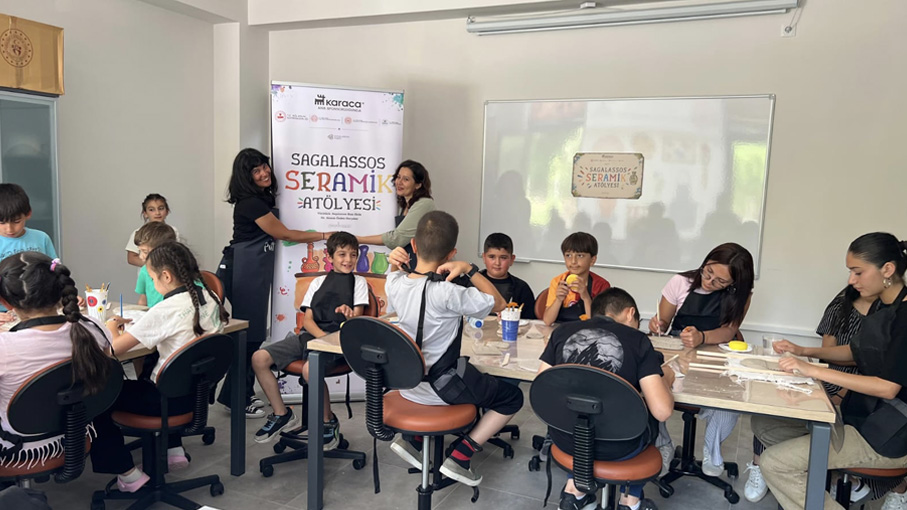
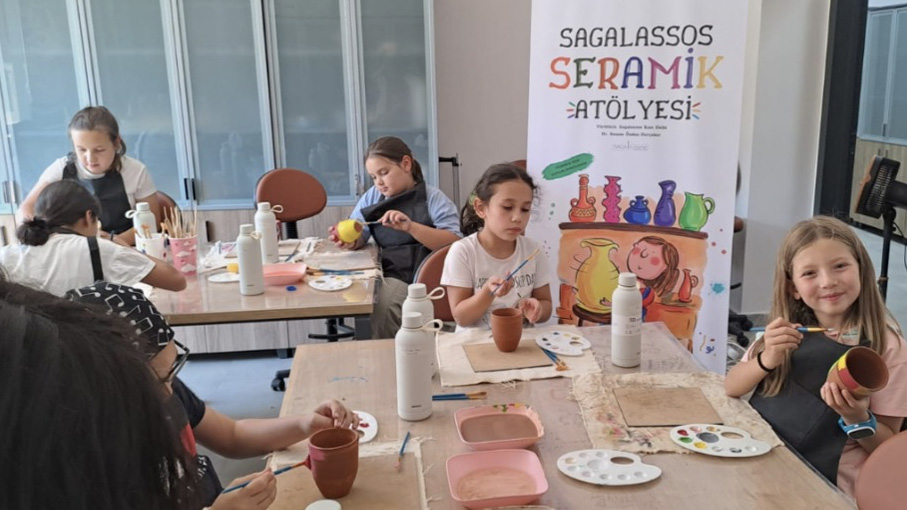
The final products and the
clay town from the workshop.

Sagalassos Pottery Workshop
Project is financially supported
by Karaca.
Investigation of the Southeast Street
& the Monumental Crossroad Area
Prof. Dr. Inge Uytterhoeven
As part of an ongoing multi-year project coordinated by Prof. Dr. Inge Uytterhoeven, the Koç University team continues its investigations of the Southeast Street and Crossroad Area (Figs. 1–2). Supported by AYGAZ, the project aims to revive the experience of moving through the ancient city along its major streets and accessing the Upper Agora.
The research focuses on the monumental crossroad area between the north–south street leading from the Imperial Roman Bath-Gymnasium complex towards the Upper Town and the Southeast Street, which entered the Upper Agora through the Southeast Arch dedicated to the Roman emperor Claudius (43–46 CE).
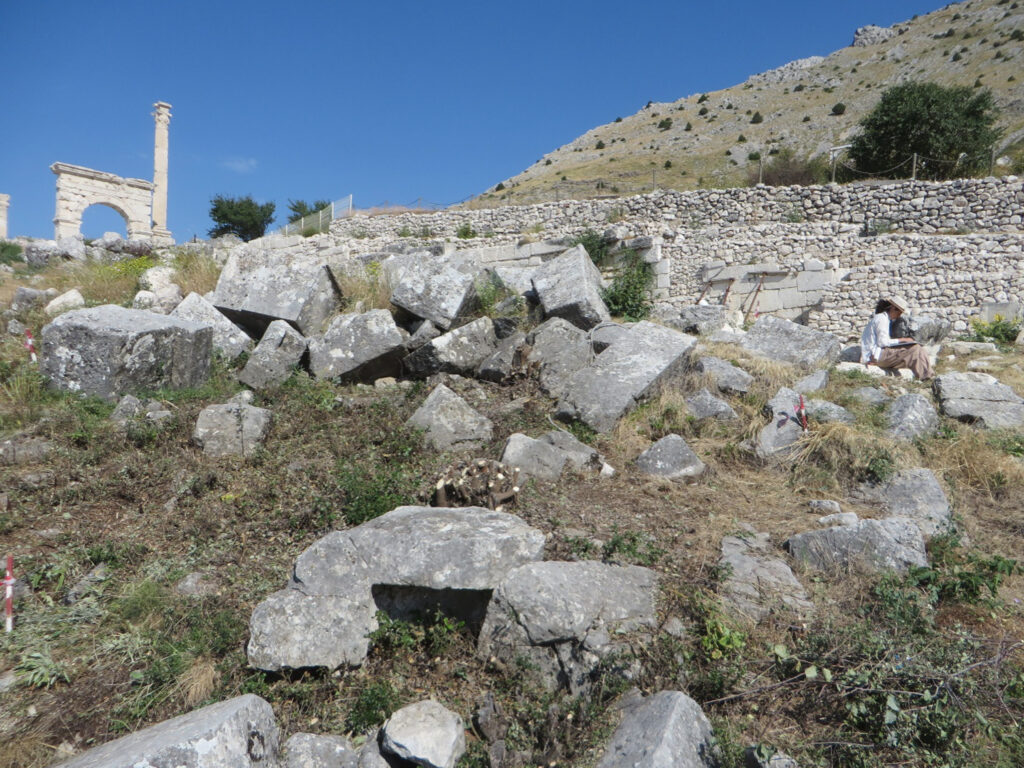
Fig. 2: View of the southern section of the excavation area
before the start of the excavations, seen from southeast.
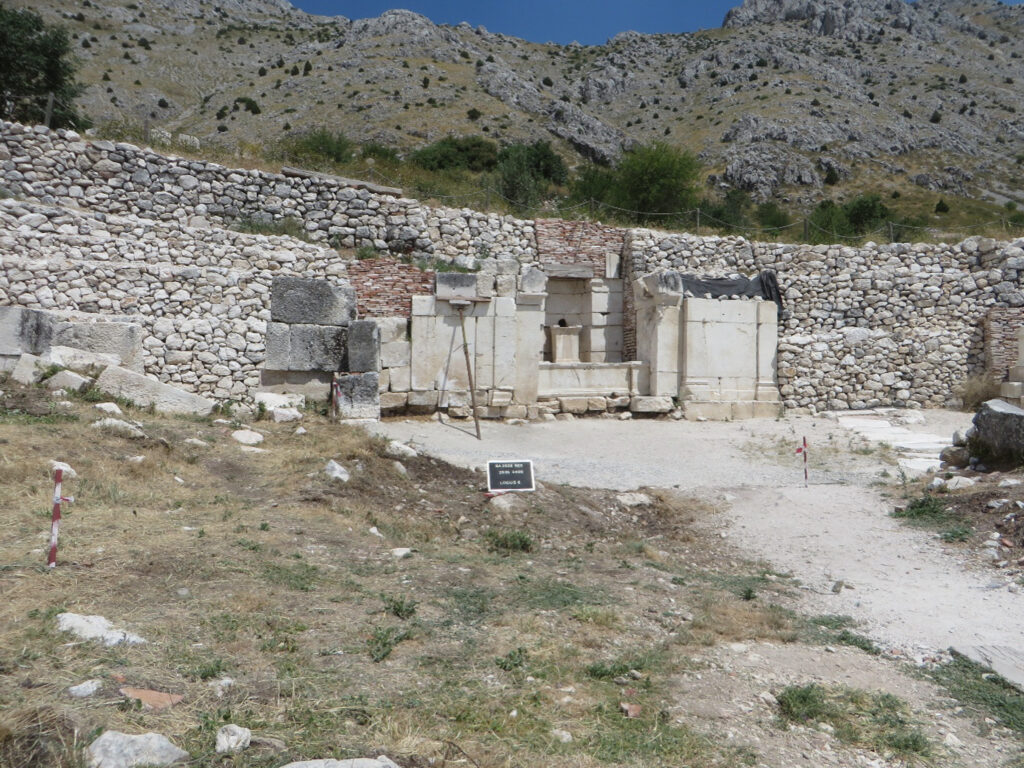
Fig. 3: View of the fountain in West Crossroads Area and
the southwest view of the Northsouth street from southwest.
To better understand the precise connection between the Crossroad Area and the North–South Street leading to the Lower Town, investigations have focused on the western and southern parts of the area (Fig. 4). The considerable difference in elevation between the southern part of the Crossroad Area and the North–South Street suggests that the street was either very steep or equipped with a staircase to overcome the difference in level. Moreover, the numerous collapsed architectural fragments found in the area seem to indicate that the southern entrance to the Crossroad Area had a monumental character.
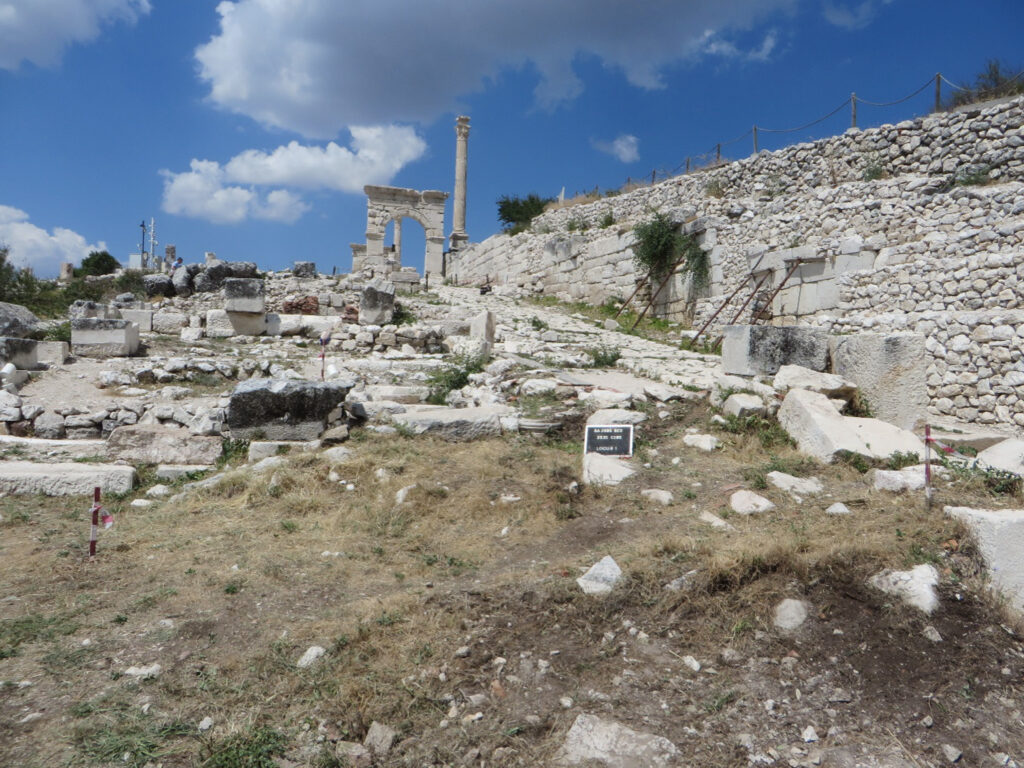
Fig. 1: View of the northern section of the excavation area
before the start of the excavations, seen from east.
As had become clear in the previous seasons, this crossroad functioned as a visible marker in the city scape for visitors climbing up from the Lower to the Upper Town. In the 2nd or early third century CE, the end point of the north-south running street was emphasised by an inscribed gate building mentioning Sagalassos as “First City of Pisidia and Ally of the Romans.” This monumentalised gate was decorated with bust of various deities (e.g., Zeus, Hermes, Apollo, and Aphrodite) and after major reconstruction interventions in the 4th c. CE, this gate was transformed into a fountain with Men statue. The inscribed statue bases placed on top of the fountain and honouring members of the imperial family and local elite members as well as the inscribed tabulae ansatae praising the city’s benefactors, which were found in the area, show that this zone was one of the strategic and visible areas of the ancient city.
On the other hand, the east side of the area was bordered by the eastern portico of the North-South Street that continued towards the north and was provided with a large canalisation system. Small spaces overbuilding the earlier sidewalk in front of this portico revealed that the area stayed in use into the 6th and 7th centuries CE (Fig. 3).
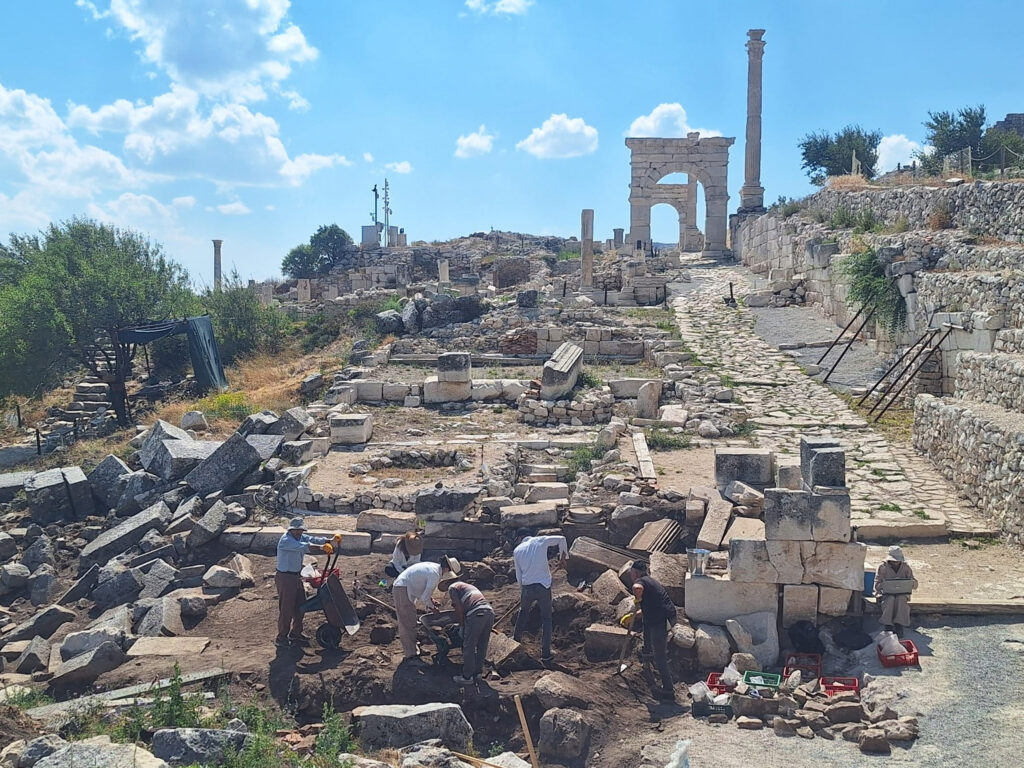
Fig. 4: View on the excavtions in the west portico of the Northsouth street from east.
Sagalassos Pottery Workshop
Project is financially supported
by Koç University.